Cutting boards for butcher shops & seafood counters
Raw protein work is the hardest test a board faces: purge, fat, blade work all day, and a sanitation standard with zero tolerance. The CHEFEAT board is non-porous TPU — nothing soaks in, the juice groove catches purge before it reaches the bench, and the surface sanitizes completely in a commercial dishwasher because knife work doesn't leave deep scores in it.
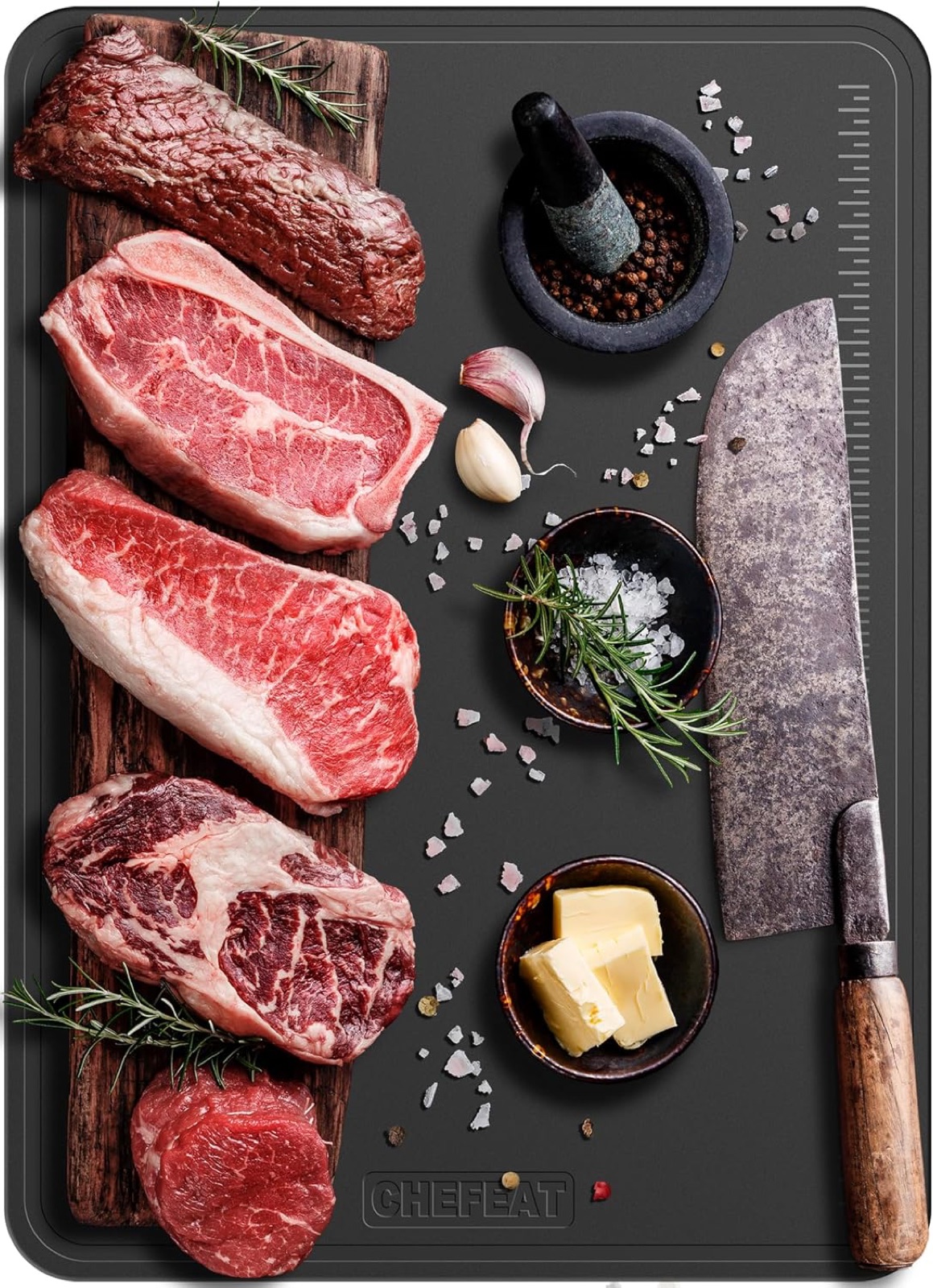
What protein work demands
1. Scored boards can't be sanitized
On hard plastic, every day of knife work cuts channels that trap protein residue — exactly what the FDA Food Code says makes a surface non-cleanable and due for discard. Elastic TPU yields under the edge instead of scarring, so the surface stays sanitizable for years, not months.
2. Purge belongs in the groove, not on the bench
The perimeter juice groove holds the liquid from a brisket or a salmon side. Bench stays dry, wipe-downs get faster, cross-contamination paths get shorter.
3. Odor is a customer-facing problem
A fish counter board that smells is a fish counter that smells. TPU scored 0 on the DIN 10955 odor and taste transfer test — it comes out of the wash neutral every time.
Where it earns its place
- Breaking and portioning: extra-large stable surface, kind to expensive breaking knives
- Counter service: bend the board to slide portions onto trays and scale pans
- Close of day: full board fleet through the dishwasher, hung to dry, done
The board, in numbers
| Work surface | 17.3 × 12.6 in (44 × 32 cm) — extra large, double-sided, perimeter juice groove on one side |
| Thickness / weight | 0.14 in (3.5 mm) · 19.4 oz — bends to funnel, rolls into any storage gap |
| Material | Food-grade Covestro (Germany) TPU — elastic, knife-friendly, non-porous, BPA-free |
| Sanitation | Commercial dishwasher safe · no oiling · resists deep scoring while surface is intact |
| Food contact | Independently tested: FDA 21 CFR 177.2600 · LFGB · EU 2018/213 (BPA) · REACH-screened — reports with numbers |
Common questions
Is it heavy-duty enough for cleaver work?
The board is designed for knife work — slicing, breaking, portioning. For heavy cleaver strikes and bone splitting, keep a dedicated chopping block; that's honest advice for any board this class.
How does it compare with the poly boards we use now?
Same dishwasher workflow, but the surface resists the deep scoring that forces poly boards into the trash — and it weighs a fraction as much. Full comparison: TPU vs plastic.
Can we run separate boards for meat and fish?
Yes — most counters order per-station sets. The double-sided design also gives each board a groove side for wet protein work and a smooth side for wrapping and trim.
Apply for a professional sample or a pilot — we reply within one business day. Or download the one-page technical sheet for your chef and purchasing team.
Apply now → Technical Sheet (PDF)More for professionals: