Cutting boards for culinary schools & training kitchens
A teaching kitchen runs boards harder than any restaurant: every station, every class, every day — with beginners. The CHEFEAT TPU board survives learner technique without scarring, is kind to the knife skills you're teaching, sanitizes between classes in the dishwasher, and a hundred boards store in the space of a dozen poly ones.
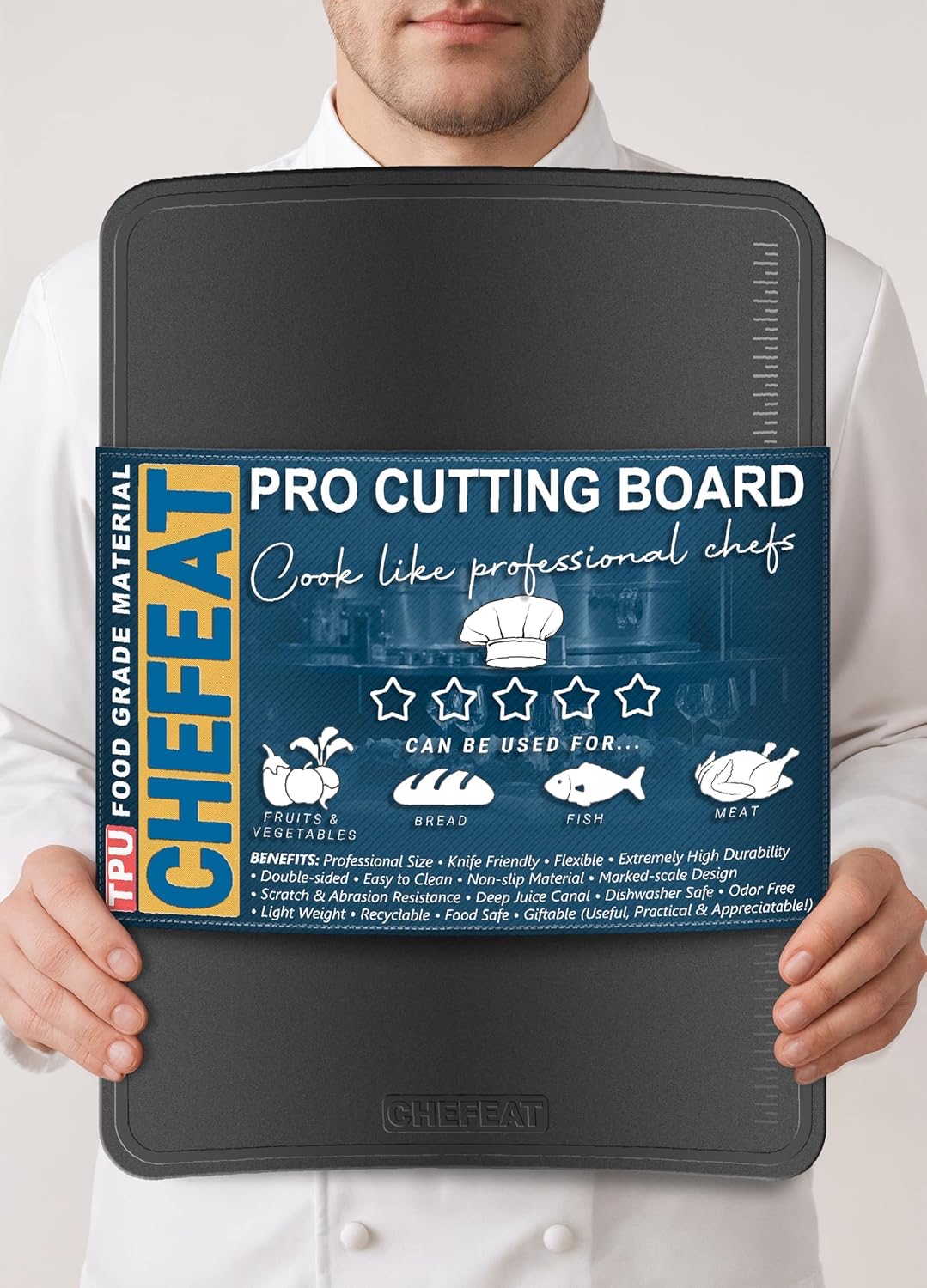
Why training kitchens standardize on it
1. Students are hard on boards — and knives
Beginner technique means pressure, bad angles and sawing. An elastic surface forgives all three: the board doesn't scar, and the school's knife fleet keeps its edge longer between sharpenings.
2. Turnover between classes is minutes, not hours
Boards go into the dishwasher with the class's tools and come out sanitized for the next group — no oiling schedule, no drying racks full of heavy poly.
3. Procurement wants one line item, not a zoo
One board standard across all stations: same specs, same certs on file, same replacement criteria, case-quantity restocking once a year instead of a running battle.
Where it earns its place
- Knife-skills classes: consistent surface for julienne drills; embossed scale doubles as a teaching aid
- Demo stations: bend-to-funnel keeps instructor demos clean and fast
- Storage: stations reset in seconds; boards stack flat or hang
The board, in numbers
| Work surface | 17.3 × 12.6 in (44 × 32 cm) — extra large, double-sided, perimeter juice groove on one side |
| Thickness / weight | 0.14 in (3.5 mm) · 19.4 oz — bends to funnel, rolls into any storage gap |
| Material | Food-grade Covestro (Germany) TPU — elastic, knife-friendly, non-porous, BPA-free |
| Sanitation | Commercial dishwasher safe · no oiling · resists deep scoring while surface is intact |
| Food contact | Independently tested: FDA 21 CFR 177.2600 · LFGB · EU 2018/213 (BPA) · REACH-screened — reports with numbers |
Common questions
Do you offer education pricing?
Qualified schools and training programs are exactly who our contract pricing exists for — apply with your station count and we'll quote per-case pricing.
How many boards per classroom?
Schools typically spec one board per station plus 20% spares; a 16-station teaching kitchen runs 20 boards per room. Case quantities map cleanly onto that.
Can students buy their own for home?
Yes — many programs put the board on the student kit list; individual boards ship via Amazon with Prime, and we can discuss a program code for cohorts.
Apply for a professional sample or a pilot — we reply within one business day. Or download the one-page technical sheet for your chef and purchasing team.
Apply now → Technical Sheet (PDF)More for professionals: