What size cutting board do you actually need?
Here's the pattern nobody tells you: most kitchen mess isn't clumsiness — it's board overflow. Onion halves rolling off the edge, herbs migrating to the counter, chopped veg carried to the pan in four batches. People blame themselves for years when the actual problem is 40 square inches of missing board.
The size classes, honestly
| Size | Actually good for | The catch |
|---|---|---|
| Small (10–12ʺ) | a lemon, an apple, a clove of garlic | real cooking overflows it instantly |
| Medium (14–16ʺ) | light solo cooking | one onion + one pepper and you're at the edges |
| Large (17ʺ+) | full meal prep, meat with a safe margin, whole watermelon | if rigid: heavy, storage-hungry, skips the dishwasher |
The three penalties of big boards — and the flexible loophole
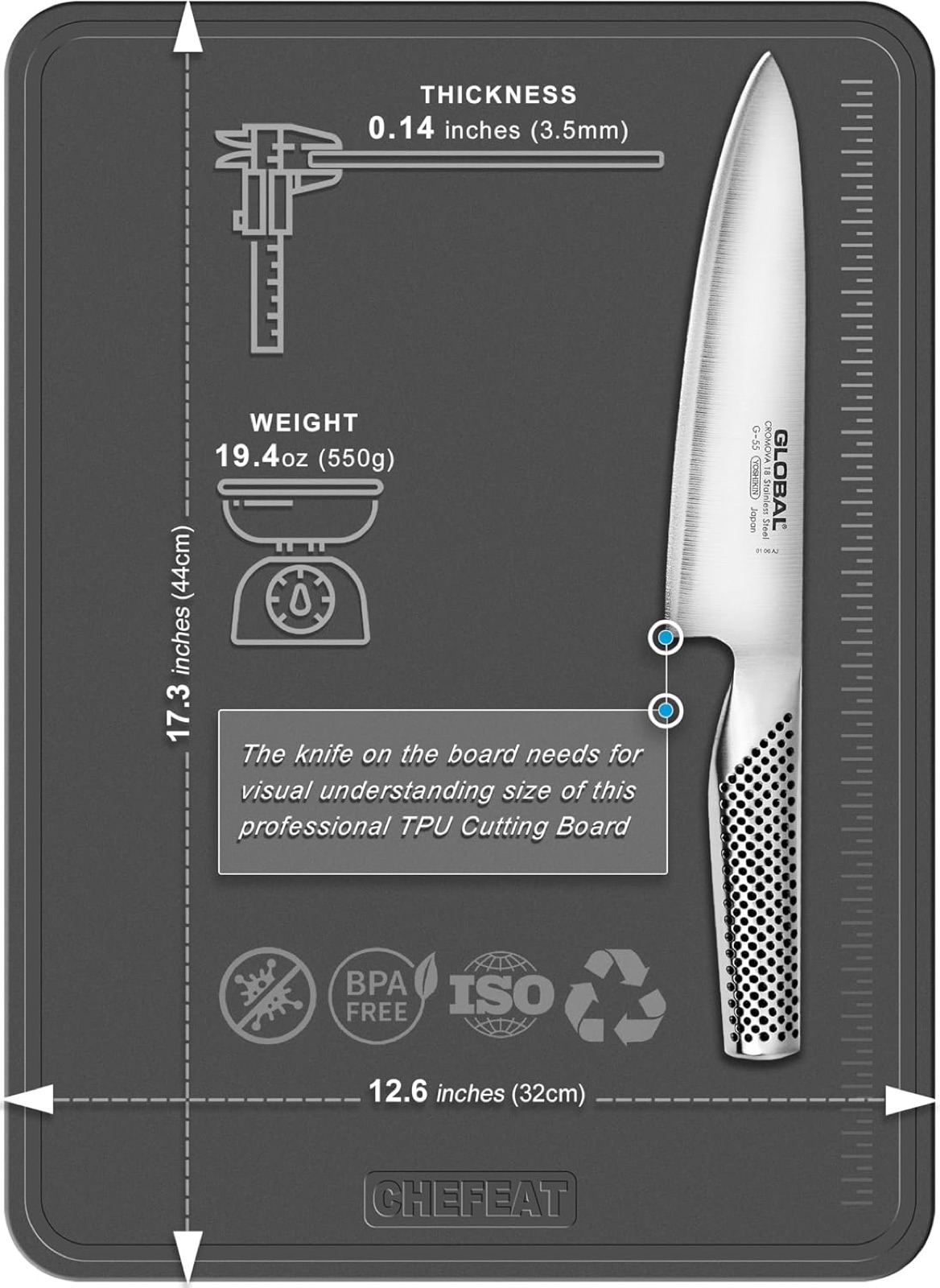
① Weight: a rigid 17ʺ board is 2–5 kg — a two-hand lift that ends up living in a cupboard. TPU at the same size: ~600 g. ② Storage: rigid needs its own slot; flexible slides into a slim gap or drawer. ③ Dishwasher: rigid 17ʺ doesn't fit; flexible bends into the rack — details in the dishwasher guide.
Thickness matters too
Thin mats (<1 mm) wobble and get sliced through; butcher blocks (30 mm+) are furniture. The working sweet spot for a flexible board is ~3.5 mm: solid under the knife, still foldable to pour. Why that matters: flexible board vs flimsy mat →
Full comparison of every board on nine factors: the best cutting board of 2026 → (Also called a chopping board in the UK.)
CHEFEAT Extra Large TPU Cutting Board17.3ʺ × 12.6ʺ — the size that ends prep overflow, light enough to use daily
Buy on Amazon →Related guides: